

Cart
0
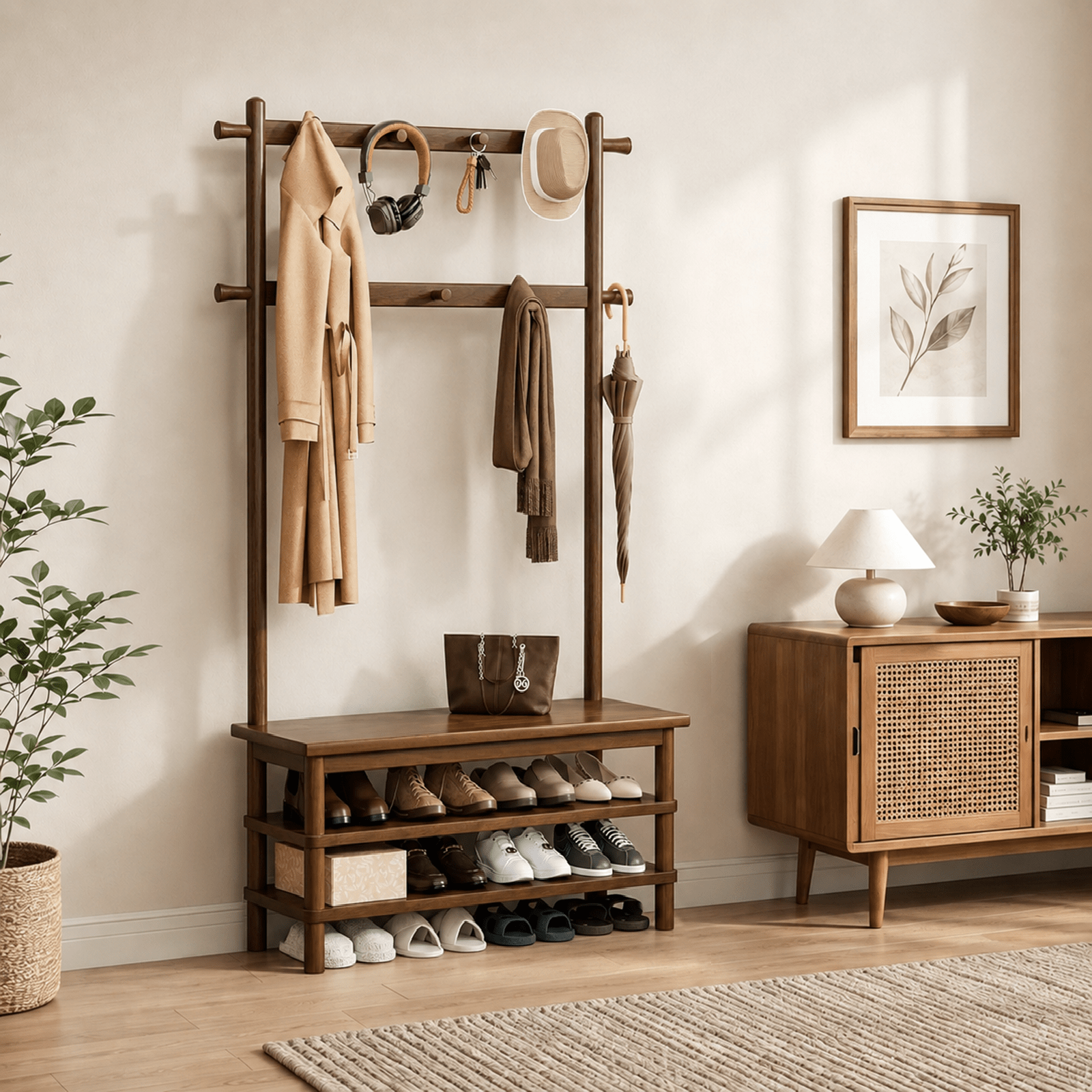
A coat rack tips over from a single mistake: too much weight on the top hooks, all on one side, on a narrow base. It's a mundane hazard with real consequences—especially in homes with toddlers who treat a hook row like a jungle gym. This coat rack safety guide explains why freestanding racks tip, how to stop it with anchoring and load discipline, and how to childproof the piece. It pairs with our weight-capacity guide and buying guide.
Why Freestanding Racks Tip
Tipping is a center-of-gravity problem. A tall post with heavy coats on the top hooks raises the combined center of mass above the base's footprint. The farther that center sits outside the base's edge, the less tipping force it takes to go over. Narrow single posts are the riskiest; wide triangular or star bases are the safest because their footprint is hard to exceed.

The Tipping Threshold
Think of it as a seesaw: the base is the fulcrum, the post is the lever. Every pound on a high hook creates a toppling moment; every pound low on the base creates a stabilizing moment. When the toppling moment beats the stabilizing moment, it goes. The fix is to move weight down and inward—load bottom hooks and shelves first, keep heavy totes low, and never hang a backpack from the very top hook.
Anti-Tip Solution 1: Wide or Weighted Base
Buy the footprint, not the height. Our triangular-base rack spreads load across three ground points; a hall tree's bench adds mass low down. A wide base literally enlarges the safe zone, so ordinary loading can't tip it.
Anti-Tip Solution 2: Wall Anchor (Renter-Safe Option)
Even a freestanding rack can be tethered. A furniture anti-tip strap or a clear adhesive anchor connects the top of the post to a wall stud or a rated anchor—no drilling into the rack, minimal wall mark, and it removes the tipping moment entirely. This is the gold standard for homes with climbers.
Anti-Tip Solution 3: Load Discipline
Three habits prevent most tip-overs: (1) bottom-first loading—coats on lower hooks, light scarves up top; (2) even distribution around the post, never all on one side; (3) lock wheels on any roller before loading, so it can't scoot into an unstable lean. Our 220-lb rack ships with lockable wheels for exactly this reason.
Childproofing
- Rounded edges & caps on hook tips—our wood racks use finished, rounded hook ends, not bare metal spikes.
- Anchor it so a toddler can't pull it onto themselves; a 30-lb child yanking a top hook generates surprising torque.
- Keep the climbable items low—don't hang a step stool or backpack where a child uses the rack as a ladder.
- Teach the load rule: coats on bottom hooks, nothing on the very top.
Load Limits & Labeling
Respect the stated rating and keep a margin. A rack rated 220 lb is happiest at ~175 lb; one rated 50 lb should never see a winter family's outerwear. If you're unsure of your load, our capacity guide walks the math. Match the rack to the room: a hall tree for the family mudroom, a tree for a calm bedroom.
Renter-Safe Anchoring
Worried about wall damage? Use adhesive furniture anchors (rated, removable) or place the rack between two walls in a corner so it can't fall into a walkway. A corner rotary is naturally braced by two planes.
Product Picks (Stable by Design)
- Triangular-base rack — widest stable footprint.
- 220-lb rack, lockable wheels — load-rated and steadied when locked.
- Hall tree — low bench mass anchors the base.
Frequently Asked Questions
Can a coat rack really tip?
Yes, if top-heavy and one-sided on a narrow base. Wide bases and low loading make it nearly impossible.
Do I need to anchor a freestanding rack?
Only if you have climbers or overload the top. A wide base + bottom-first loading is enough for most adults-only homes.
Are adhesive anchors strong enough?
Rated furniture anchors hold far more than a child's pull and remove cleanly—ideal for renters.
Which base is safest?
Triangular or star bases beat narrow posts; a hall tree's bench adds stabilizing low mass.
How do I childproof hooks?
Choose rounded, finished hook ends (ours are), anchor the rack, and keep climbable items off the top.
Do lockable wheels help safety?
Yes—locking prevents the rack from rolling into an unstable lean when loaded.
What's the safe load margin?
Stay around 80% of the rating; a 220-lb rack is happiest near 175 lb of distributed load.
Final Takeaway
Safe coat storage is three choices: a wide base, bottom-first even loading, and an anchor where kids climb. Pair these habits with a load-rated rack from the entryway collection, and revisit the buying guide to choose well.
By the TAITIY Furniture Team.

