Cart
0

A shoe bench is the one piece that turns a chaotic front door into a functioning drop zone. It gives you a place to sit and untie laces, hides the shoe pile behind a tidy facade, and anchors the entryway's first impression. Yet most buyers grab the first bench they see and discover too late it's the wrong height, too short for the family's shoes, or impossible to clean. This shoe bench buying guide is built on the specs that actually matter: type, dimensions, capacity, material, and where it will live. Along the way we link our white multi-tier shoe bench and upholstered storage bench so you can go from reading to buying in one sitting.
The entryway is the highest-traffic square foot in the home, and shoes are its biggest clutter source. A bench solves three problems at once: it gives you a seat to remove footwear, it stores shoes off the floor, and it visually closes the mess behind a flat top or doors. In homes without a mudroom, a shoe bench is the single highest-ROI piece you can add. The ergonomics matter too: bending to tie shoes strains the lower back; a 18" seat lets hips and knees sit at a comfortable right angle. Pair the decision with our coat rack guide to complete the drop zone.

| Type | Best for | Capacity | TAITIY example |
|---|---|---|---|
| Open multi-tier shoe bench | Visible, airy storage | High (stacked tiers) | white multi-tier |
| Cushion-top storage bench | Comfort + hidden storage | Medium (inside) | gray cushion bench |
| Upholstered storage bench | Living-room comfort | Medium (inside) | upholstered bench |
| Hall tree with bench | Coats + shoes + seat | High (shelves + hooks) | 11-hook hall tree |
| Storage ottoman | Flexible, movable seating | Low–medium | reversible-lid ottoman |
Open tiers suit families who want to grab-and-go; lidded benches suit minimalist entries that hide everything; hall trees win when you also need coat hooks. For a direct compare, see our shoe bench vs. storage bench breakdown.
Quick rule: a shoe bench is sized for footwear and often open; a storage bench is a deeper, lidded box for blankets, toys, or shoes; a hall tree adds hooks above. If you only need shoes, a shoe bench is enough. If you want to hide non-shoe items too, a storage bench. If coats are the problem as well, a hall tree. Our comparison lays out the trade-offs with a decision table.
Comfort and fit come down to three numbers:
Use this worksheet: measure your wall width, the door's arc, and the tallest shoe pile. Most entryways fit a 30–40" bench with room to spare. If you're tight, our small-entryway guide shows how to fit function into less width.
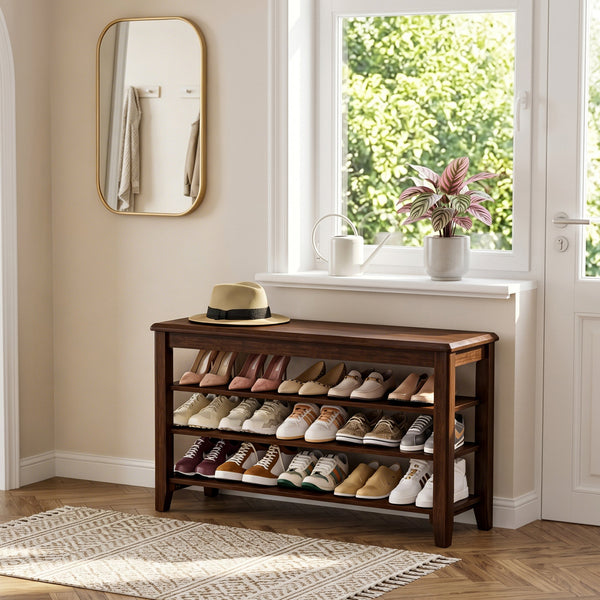
Open multi-tier benches hold the most pairs because shoes stack on shelves. A three-tier rubberwood bench with adjustable shelves can stage 9–12 pairs; a lidded bench hides 4–6 pairs plus bulk items. Count your household's daily shoes (not the full closet) to size correctly—most homes need 6–10 visible pairs by the door.
| Material | Look | Durability | Cleanability |
|---|---|---|---|
| Solid wood (rubberwood, walnut accent) | Warm, natural | High; refinishable | Wipe + oil |
| Faux-leather top | Sleek | High | Wipe clean |
| Upholstered (fabric + foam) | Soft, cozy | Medium | Spot clean |
| Metal frame | Modern, slim | High | Wipe |
Wood leads in living entries because it's warm and repairable; faux-leather tops shrug off muddy prints; upholstery wins on comfort but needs fabric care. We go deeper in our wood vs. upholstered bench guide.
| Finish | Pairs with | Vibe |
|---|---|---|
| White | Light, airy entries | Clean, modern |
| Walnut / wood | Warm traditional | Cozy, natural |
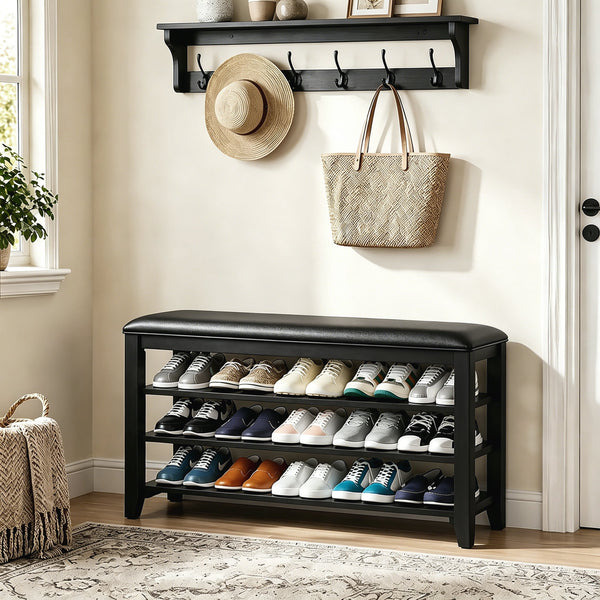
| Black faux-leather | Modern, high-traffic | Sleek, easy-care |
| Gray cushion | Soft minimalist | Calm, padded |
Our black faux-leather bench is the easy-care pick for messy entries; the white bench brightens small ones.
A bench seat should hold a seated adult safely—look for a static rating around 250–300 lb for the seat. Cushioned and upholstered tops add comfort for longer sits (putting on boots); solid wood tops are firmer but fine for quick shoe changes. Understand the difference between static rating (a still seated person) and dynamic (someone dropping onto it)—buy to the static number and you'll have margin. The frame, not the top, carries the load: a well-joined wood or steel base is what prevents wobble.
For families, open shelves beat lids—kids actually put shoes away when they can see the spot.
In tight entries, go vertical: a taller multi-tier bench stores more pairs in the same floor print. A storage ottoman tucks against a wall and moves when guests come. See our small-entryway guide for the full playbook.
Anchor tall hall trees to the wall, choose soft-close lids to prevent finger pinch, and avoid benches with tempting climbable rungs near toddlers. A low, wide bench is inherently stable and safer for kids learning to sit and tie. If a child will use it daily, set the seat at the lower end of the 17–19" range.
Dogs and cats treat open tiers as highways. Closed-front or lidded benches keep paws (and fur) out of the shoes; leashes belong on a low hook, not the tiers. A wipe-clean top handles paws far better than upholstery.
Wood: dust weekly, wipe spills at once, oil monthly. Faux-leather: wipe with a damp cloth. Upholstery: vacuum the top and blot spills immediately with a clean cloth—never rub. Seasonal task: tighten hardware each spring and fall; wood shifts with humidity. A five-minute routine twice a year adds years of life.
| Tier | Price | What you get |
|---|---|---|
| Entry | ~$210 | Solid wood open shoe bench |
| Mid | ~$250–$290 | Adjustable tiers or cushioned top |
| Premium | ~$385 | Upholstered, deeper storage |
A solid-wood bench from managed forests is renewable and repairable—loose joints are glue-and-clamp, scratches sand-and-oil. Upholstered frames are harder to refresh but last well if the frame is solid. Buy once, maintain, and you avoid the landfill cycle of flat-pack furniture.
17–19" matches a standard chair seat; choose the lower end if kids use it most.
Open three-tier benches hold 9–12 pairs; lidded benches hide 4–6 pairs plus bulk items. The rubberwood bench is a high-capacity pick.
Wood is warmer and easier to maintain; upholstery is more comfortable. See our material guide.
Lids hide clutter but slow access; open shelves get more daily use in families. Pick by who uses it.
Yes—use a tall multi-tier or a storage ottoman. More in our small-entryway guide.
Use breathable baskets inside lidded benches, air them weekly, and add a charcoal sachet.
A solid-wood frame with a faux-leather or wood top—like our black faux-leather bench.
Only tall hall trees; low benches are stable on their own. Anchor if you have climbers.
White or black wood with clean lines, or a gray cushion bench for softness.
A low, sturdy bench can, if the top is flat and cleared of shoes.
A maintained wood bench lasts a decade-plus; upholstered 8–12 years with frame care.
Trust the static number (250–300 lb); it leaves margin over dynamic drops.
Yes—a small tray stops keys and mail from colonizing the shoe tiers.
Choose by visibility first, size second, material third. Start with our white multi-tier bench for airy storage or the upholstered bench for comfort, then browse the entryway collection.
Written by the TAITIY Furniture Team. We design and ship entryway furniture and update this guide as we learn what actually holds up in real homes.