

Cart
0
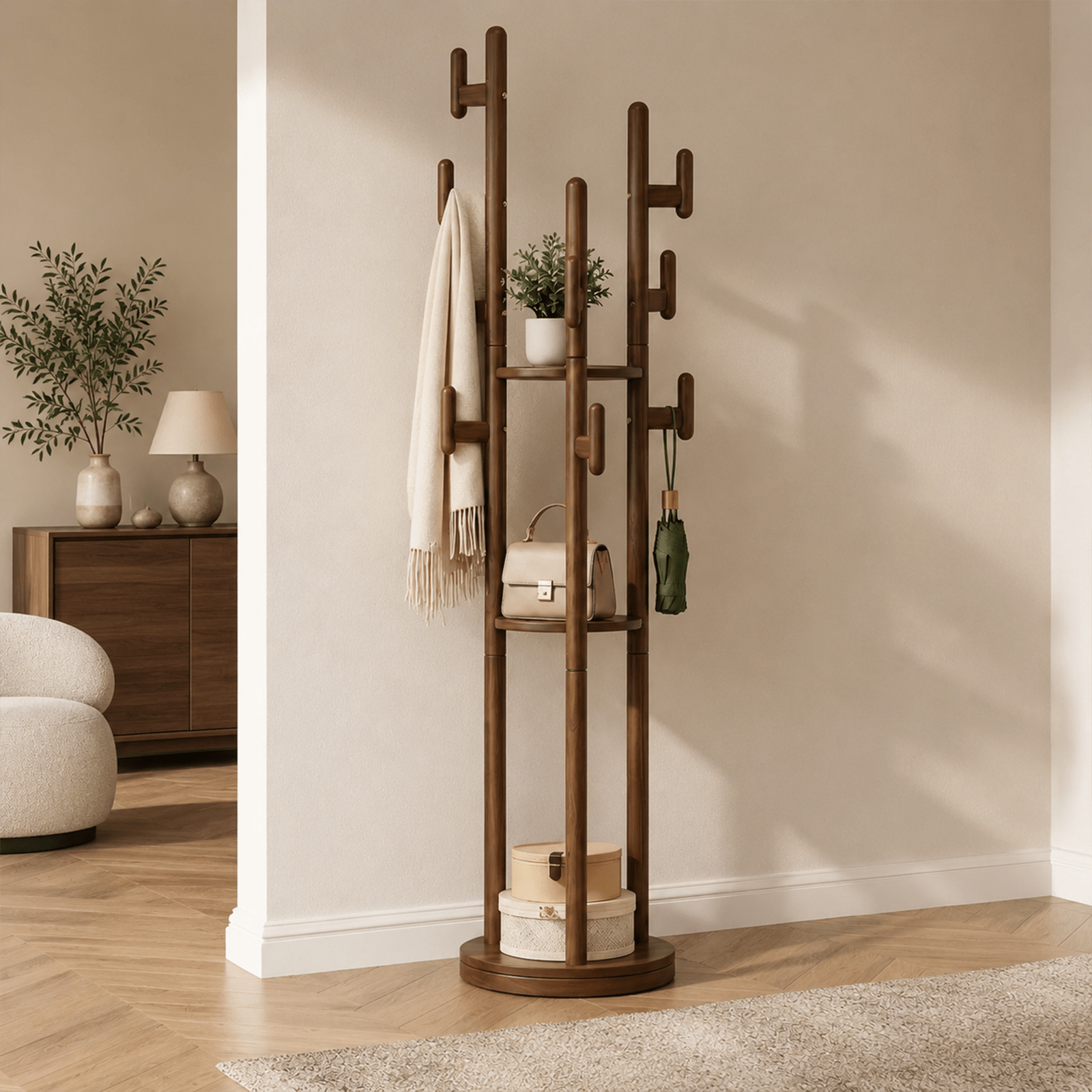
A rotary coat rack—also called a spinning or carousel coat stand—solves the oldest entryway problem: you pile coats on the one reachable hook and the rest fall behind. Because it spins, nothing is "behind" anything. This guide explains how a rotary fits more in less floor space, the swivel that makes it work, what to store on its tiers, how much it holds, and why our 9-hook wooden rotary is the corner-capacity king. See it next to other types in our buying guide.
How a Rotary Works
A rotary is a vertical post on a swivel base with hooks on two or three tiers and often open shelves between them. You spin the core to reach the back instead of reaching around—so a 9-hook rotary in an 18" footprint holds what a 40" wall row holds. That makes it the highest-capacity freestanding form per square foot.

The Swivel Mechanism Explained
The magic is a lazy-Susan-style bearing at the base: a ring of ball bearings lets the post rotate with light hand pressure but enough drag to stay put when bumped. A good rotary won't spin from a passing draft or a coat's weight—it turns only when you push it. Cheap versions use a loose bushing that wobbles and loosens; ours seats the post on a sealed bearing rated for daily family use, so it stays smooth for years without lubrication.
Why Choose a Rotary?
- Corner-friendly. A round base tucks into a dead corner a rectangular rack can't use.
- No "back" row. Spin to access every hook; nothing gets buried.
- Shelves included. Most rotaries add 2–3 open shelves for baskets and bags.
- Family-scale. 9 hooks serves a household of four without a wide bench.
Capacity & What to Store
| Feature | Our 9-hook rotary |
|---|---|
| Hooks | 9 (two tiers) |
| Shelves | 3 open shelves |
| Footprint | ~18" diameter |
| Best for | Corner, family entry, office |
Use the hooks for coats, hats, and bags; the shelves for woven baskets of scarves, mittens, and a folded umbrella. Because it spins, kids can reach their own hook without climbing.
Best Rotary for Different Household Sizes
- Single / couple: a 5–7 hook rotary is plenty and slimmer.
- Family of four: the 9-hook, 3-shelf model covers daily outerwear plus a basket tier.
- Home + office shared: size up so visitors' coats don't crowd yours.
When in doubt, a hook of headroom beats a cramped rack—overflow coats get dropped on the floor.
Rotary vs. Tree vs. Wall
- Rotary vs. tree: a tree is slimmer and taller; a rotary holds more and adds shelves. See our coat stand guide.
- Rotary vs. wall: wall rows need drilling and a stud; a rotary is portable and renter-safe—see freestanding vs. wall-mounted.
- Rotary vs. hall tree: a hall tree adds a bench; a rotary adds spin and a smaller footprint.
Stability & Safety
A rotary's round base is naturally stable, but load it like any freestanding rack: heavy items low, spread evenly, and don't yank a top hook. Our safety guide covers anchoring for homes with climbers. Pair it with storage-shelves thinking so the tiers stay useful, not cluttered.
Styling a Rotary in Open-Plan Homes
In an open living/dining space, a wooden rotary doubles as a soft room divider: place it at the edge of the entry so coats stay contained without a closed closet. The round form reads as sculpture rather than hardware, and the shelves hold a basket that hides the day's odds and ends—keeping the sightline calm.
Maintenance & Cleaning
- Weekly: dust the post and shelves with a dry cloth.
- Monthly: wipe shelves with a damp cloth, dry at once; check the base bearing for grit.
- Seasonally: tighten hook screws; a drop of dry lubricant on the bearing keeps the spin smooth (avoid wet oils that attract dust).
Rotary Buying Checklist
- Sealed bearing at the base (not a loose bushing).
- Two hook tiers so long and short items separate.
- At least 2 open shelves for baskets.
- Rounded, finished hooks that won't snag wool.
- Wide round base with a low center of gravity.
Product Pick
- 9-hook wooden rotary, 3 shelves — the corner-capacity pick.
- For a slimmer alternative, the 10-hook tree trades shelves for height.
Frequently Asked Questions
Do rotary coat racks spin smoothly?
A good one spins on a swivel base with light resistance—enough to stay put when bumped, easy to turn by hand.
How many coats fit on a 9-hook rotary?
Nine hanging items plus shelves of baskets; comfortably a family of four's daily outerwear.
Is a rotary stable?
Yes—the round base is wide for its height. Load low and evenly; anchor if kids climb (see safety guide).
Can I use it in a bedroom?
Absolutely—a rotary is great in a bedroom corner for tomorrow's outfit and a bag; see our bedroom guide.
Wood or metal rotary?
Wood reads warmer and hides wear; metal is slimmer. We build wooden rotaries for visible rooms.
Does it need wall clearance?
Just the 18" diameter plus a little spin room—no wall contact, so it's renter-safe.
Will the bearing wear out?
A sealed bearing lasts years of daily spins; if it ever loosens, tighten the base bolt—no part needs replacing for typical home use.
Can a rotary hold heavy winter coats?
Daily coats, yes. For very heavy wardrobes, size up to our 220-lb rated rack.
Is a rotary easy to move?
Yes—lift it by the post; the round base rolls through a doorway without tilting.
Rotary in a Rental: No-Drill Tips
Because a rotary never touches the wall, it's the most renter-safe high-capacity option—no stud finder, no patching at move-out. Place it in a corner so it can't be knocked into paint, and if you want extra steadiness on a slick floor, a small non-slip pad under the base adds grip without adhesive. For more renter strategy, see freestanding vs. wall-mounted.
Final Takeaway
Pick a rotary when you want maximum capacity in a corner with zero wall contact. Our 9-hook wooden rotary pairs spin access with three shelves. Browse the entryway collection and revisit the buying guide.
By the TAITIY Furniture Team.

