

Cart
0
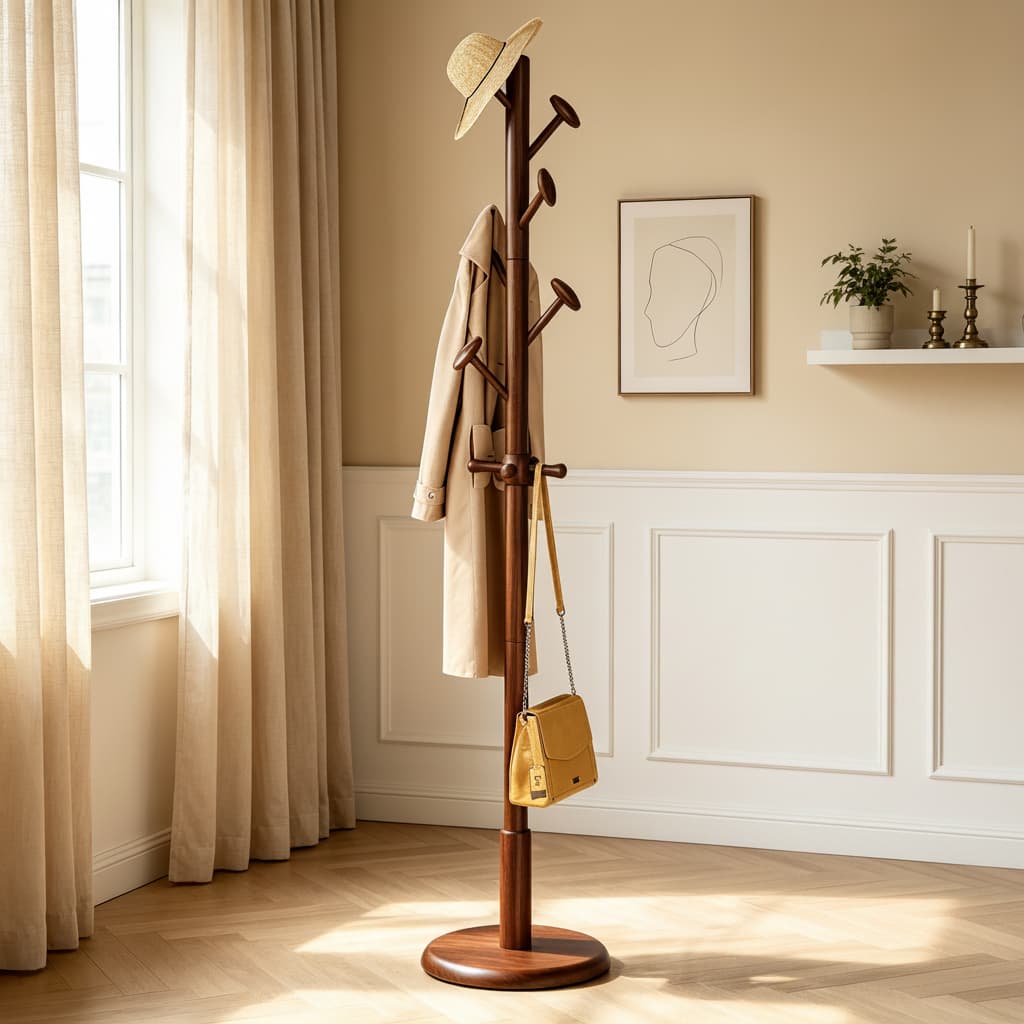
A wooden coat rack does what metal can't: it makes a utility object feel like furniture. The grain, the warmth, the way it hides a scuff instead of showing it—solid wood is the right call for any entry, bedroom, or office where the rack is seen, not hidden. This guide covers why wood outperforms for visible spaces, the types worth knowing, how to size one, how to care for it, and the best rubberwood tree and walnut-look rack we build. Start from our full coat rack buying guide if you haven't chosen a type yet.
Why Choose Wood Over Metal?
Both materials carry coats; they differ in where they live and how they age. Solid wood (we use rubberwood and walnut-accent frames) reads warm, hides scuffs, and is repairable—sand and re-oil a scratched post and it looks new. Metal (powder-coated steel) is slim, modern, and often rated for higher loads, but a chip exposes bare steel that rusts in a damp entry. For any room guests see, wood wins on looks and longevity; for a garage or laundry, metal is fine. We go deeper in our wood vs. metal guide.

Anatomy of a Quality Wooden Rack
Before you compare models, learn the four parts that decide whether a rack lasts a decade or a season:
| Part | What good looks like | Red flag |
|---|---|---|
| Base | Wide, weighted, or triangular for a low center of gravity | Narrow post on a tiny foot |
| Joints | Wood-to-wood dowel or screwed, glued under load | Plastic clip-ons that flex |
| Hooks | Rounded, finished wood or capped metal | Bare sharp wire that snags coats |
| Finish | Sealed lacquer or oil that wipes clean | Raw, unsealed surface that stains |
Our triangular-base stand is built around a wide, low footprint because base design is the single biggest predictor of stability.
Rubberwood vs. Walnut-Accent
Most of our wooden racks use rubberwood—a dense, sustainable hardwood with a pale, even grain that finishes cleanly and costs less than tropical hardwoods. Our walnut-accent pieces keep a rubberwood core but wear a deeper brown lacquer for a richer, more traditional look. The difference is cosmetic and structural: both are real wood, both repair, both hold daily coats. Pick walnut for a formal entry, rubberwood for a bright, Scandi feel.
Types of Wooden Coat Racks
| Type | Best for | TAITIY example |
|---|---|---|
| Tree / pole stand | Bedrooms, offices, corners | 10-hook tree |
| Rack with shelves | Drop zone + baskets | 2-shelf, 5-hook |
| With storage basket | Families, loose items | basket 5-hook |
| Hall tree | Mudrooms, seating | 11-hook hall tree |
| Rotary | Corner, high capacity | 9-hook rotary |
How to Size a Wooden Coat Rack
- Count users. A 2-person household shares a 5-hook rack; a family of four wants 9–11 hooks.
- Measure clearance. Tree stands need ~60" of vertical room; a rotary is shorter and wider.
- Leave a lane. Keep 30–36" of clear floor in front for foot traffic.
- Mind the swing. Near a door or stairs, a corner or rotary hugs the wall better than a wide bench.
Our bedroom guide and storage-shelves guide go deeper on those rooms.
How to Choose Wood for Your Climate
Wood moves with humidity, so match species and finish to the room. In dry, heated homes, choose a sealed lacquer (our walnut-accent line) and keep a small humidifier nearby so posts don't shrink and joints don't loosen. In humid coastal or unconditioned entries, rubberwood with an outdoor-rated sealant copes better, but avoid placing any wood rack where rain or snow lands. For a damp mudroom with no climate control, our metal or hybrid guide explains safer picks. The rule: wood belongs in climate-controlled, covered spaces.
Sustainability & Sourcing: Why Rubberwood
Rubberwood is a by-product hardwood: it comes from rubber trees that have finished their latex-producing life (roughly 25–30 years) and would otherwise be burned. Milling them into furniture captures embedded carbon and gives the tree a second economic life, so choosing rubberwood is a low-impact pick that doesn't fund new deforestation. It's also dense and workable, which is why it finishes smoothly and holds screws well—good for a rack that's assembled and moved over years.
Matching Wood Tone to Room Style
- Scandinavian / bright modern: pale rubberwood with a clear or white finish keeps the room airy.
- Mid-century / warm modern: walnut-accent reads richer against olive, terracotta, and cream walls.
- Traditional / formal: deeper walnut with brass-capped hooks suits wainscot and rug-heavy entries.
- Industrial: pair wood with a metal base (our wheeled hybrid) for the wood-and-steel look.
Finish, Durability & Assembly
Finishes should match use: a walnut or white lacquer suits living spaces; both wipe clean of muddy prints. Most of our wooden racks are tool-light to assemble—posts slot together, hooks screw on, done. Because wood is repairable, a moved home or a teething puppy isn't the end of the rack; a light sand and re-oil restores it.
Care by Wood Type
| Task | Rubberwood | Walnut-accent |
|---|---|---|
| Dusting | Soft dry cloth weekly | Soft dry cloth weekly |
| Deep clean | Damp cloth, dry at once | Damp cloth, dry at once |
| Protection | Monthly plant oil | Quarterly wax |
| Hardware | Tighten hooks seasonally | Tighten hooks seasonally |
Keep wood racks in climate-controlled rooms, away from direct vents and windows, so they don't dry or swell. Full safety notes are in our anti-tip guide.
Common Buying Mistakes
- Buying on hook count alone. A 12-hook rack on a narrow base tips; spread capacity across a wide or triangular base instead.
- Ignoring ceiling height. A 60" tree under a 54" shelf won't fit—measure before you buy.
- Putting wood in a wet entry. Unsealed wood in a snowy, unconditioned mudroom stains and swells.
- Skipping the wall anchor. Tall trees in homes with climbers need a strap—see safety.
- Choosing metal for a visible room. Metal shows every chip; wood ages better in sight.
Wooden vs. the Rest: A Quick Map
- Wood vs. metal: wood for looks and repair, metal for load and utility—see the full comparison.
- Freestanding vs. wall: wood freestanding is portable and renter-safe—see freestanding vs. wall-mounted.
- With vs. without storage: shelves and baskets turn a rack into a drop zone—see storage-shelves guide.
Product Picks (Wooden)
- 10-hook tree stand — compact solid wood for bedroom or office.
- 2-shelf, 5-hook (Size L) — walnut-look, drop-zone ready.
- 5-hook with basket — catches gloves and scarves.
- 11-hook hall tree — wood + bench + shoe storage.
Frequently Asked Questions
Is a wooden coat rack sturdy enough?
Yes—well-joined hardwood carries daily coats for a decade; choose a wide base (our triangular base) for extra steadiness.
Do wooden racks scratch easily?
Less than metal—wood hides scuffs, and a scratch sands out. Metal shows chips that can rust.
Which wood is best for an entry?
Rubberwood for bright, modern spaces; walnut-accent for formal, traditional entries.
Can I repair a wooden coat rack?
Yes—sand and re-oil scratches, tighten joints seasonally. Wood is the most repairable material we sell.
Is rubberwood real wood?
It's a dense, sustainable hardwood—real wood, not particleboard—with a fine, even grain.
Will wood warp in a mudroom?
Only with moisture or heat; keep it climate-controlled and away from vents. For damp, unconditioned mudrooms, a metal or hybrid is safer.
How do I stop a wooden rack tipping?
Wide base + bottom-first loading; details in our safety guide.
Does wood hold heavy winter coats?
Daily family coats, yes. For very heavy wardrobes, size up to our 220-lb rated rack.
Is a wooden rack safe with kids?
With a wall anchor and bottom-first loading, yes—see the anti-tip guide.
How long does a wooden coat rack last?
A well-joined, sealed wooden rack lasts 10+ years of daily use and can be refinished rather than replaced.
Should I oil or wax the finish?
Oil monthly for rubberwood, wax quarterly for walnut-accent; both keep the surface sealed against humidity.
Can I use a wooden rack in a bedroom?
Ideally—wood reads warm in a bedroom; see our bedroom guide for placement.
Wood Species Deep-Dive: Rubberwood, Walnut & Oak
| Species | Look | Durability | Best room |
|---|---|---|---|
| Rubberwood | Pale, even grain | Hard; dents rather than cracks | Bright, modern |
| Walnut-accent | Deep brown lacquer | Same hardwood core | Formal, traditional |
| Oak (if offered) | Open, pronounced grain | Very hard | Rustic, cottage |
All three are real hardwoods that repair; the difference is color and grain, not strength. Rubberwood is our default for sustainability and value, walnut-accent for a richer look, oak for a pronounced grain in rustic rooms.
Step-by-Step Assembly
- Sort parts on the floor; confirm base, post, tiers, and hooks are present.
- Attach the base to the post first—this is the stability-critical joint.
- Add tiers and hooks from bottom up, tightening each as you go.
- Stand and level; if it rocks, the base isn't fully seated.
- Load bottom-first to check steadiness before daily use.
When Wood Is the Wrong Choice
Be honest about limits: in a damp, unconditioned mudroom or a garage, a sealed metal or hybrid rack outlasts wood because it shrugs off moisture and impact. Wood also costs more up front than a basic metal stand. Choose wood when the rack is seen and climate-controlled; choose metal when it's hidden or wet—our wood vs. metal guide lays out the cutoff.
Pairing Your Wooden Rack With Other Entry Pieces
A wooden rack is one third of a complete entry: pair it with a rubberwood shoe bench for seated shoe changes, and a basket rack for the loose items a hook can't hold. The trio—rack, bench, basket—turns a bare wall into a working drop zone. See our storage-shelves guide for the full system.
Cost vs. Value Over 10 Years
A wooden rack costs more than a metal one on day one, but it repairs instead of replacing: a sand-and-oil refresh costs pennies and resets the clock, while a chipped metal rack is usually thrown away. Over a decade of daily use, the repairable wood piece is often the cheaper one—and it looks better the whole time.
Reading the Spec Sheet Before You Buy
| Spec | What to check |
|---|---|
| Base diameter | Wider = steadier; >14" for a tree |
| Hook count & height | Two tiers beat one; count long-coat clearance |
| Finish | Sealed lacquer or oil, not raw wood |
| Weight rating | Match to your heaviest daily load |
| Assembly | Tool-light, dowel joints, not clip-ons |
Wood Finish Types: Lacquer vs. Oil vs. Paint
Three finishes dominate wooden racks. Clear lacquer seals the grain, wipes clean, and suits pale rubberwood in bright rooms. Penetrating oil (our walnut-accent line) sinks in for a hand-rubbed look and is the easiest to refresh—re-oil a worn spot, no stripping. Paint hides grain for a bold color pop but chips at edges and can't be sanded back as easily. For a visible rack you'll keep for years, lacquer or oil beat paint on repairability.
Warranty & What Good Support Looks Like
A wooden rack should come with a real warranty and reachable support, because the parts that fail are joints and hooks, not the wood. Look for at least a 1-year cover on hardware, spare hooks on request, and a maker who answers. We stock spare pegs and ship replacement bases, so a moved or knocked rack is a parts order, not a trash run.
Final Takeaway
Choose wood when the rack is seen and meant to last: it looks better, hides wear, and repairs. Match rubberwood or walnut to your room, pick a wide base, and pair it with a wooden shoe bench for a complete entry. Browse the entryway collection and revisit the buying guide.
By the TAITIY Furniture Team.

