

Cart
0
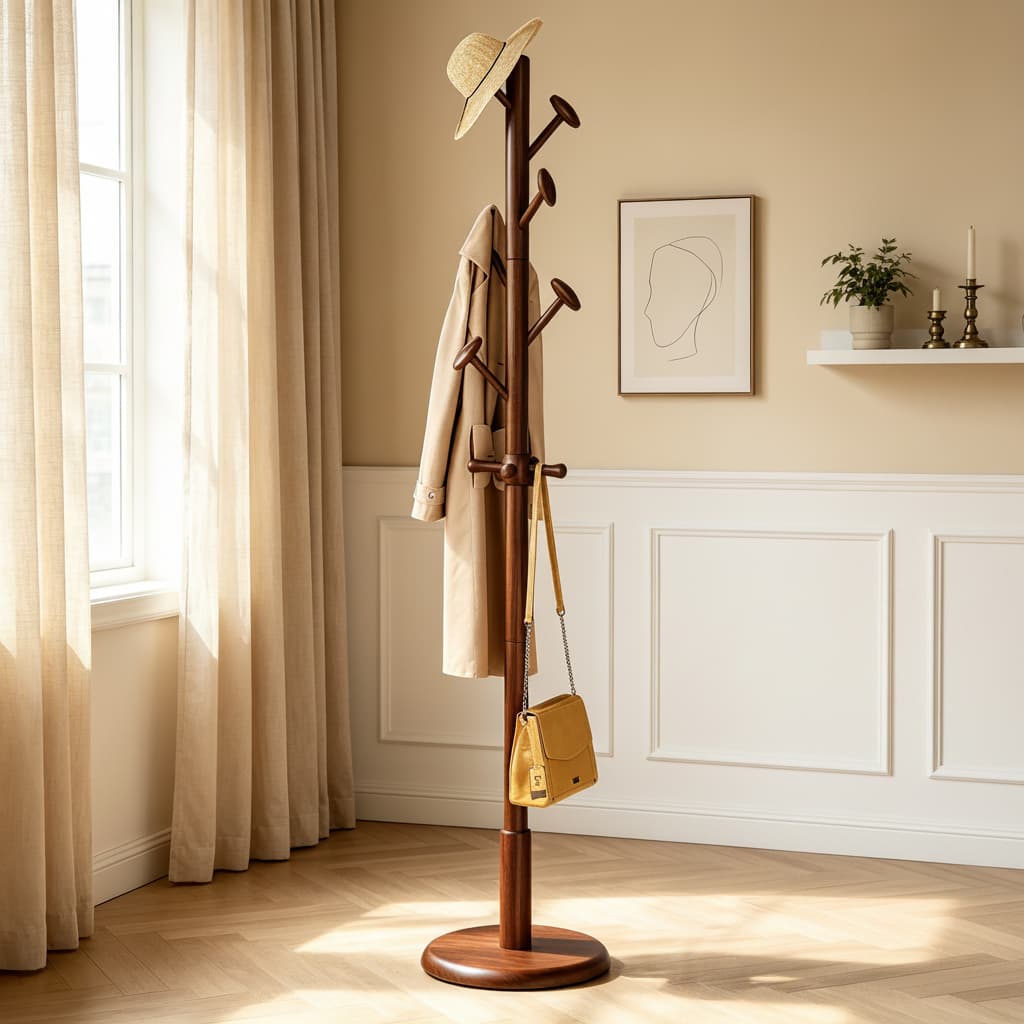
Choosing between a freestanding coat rack and a wall-mounted coat rack is the first real fork in any entryway project. One sits on the floor and moves with you; the other is bolted to the wall and disappears into the room. This guide settles the debate with numbers, not vibes: we compare the two on capacity, installation, stability, renter-friendliness, and lifetime cost, then point you to the 10-hook freestanding tree and the 11-hook hall tree we actually sell. Start with our full coat rack buying guide if you haven't narrowed the type yet.
What Is a Freestanding Coat Rack?
A freestanding coat rack is a floor-standing unit that needs no wall connection. The family includes tree/pole stands (a vertical post with radiating hooks, like our 10-hook tree), rotary carousels (a spinning core with shelves, such as the 9-hook rotary), hall trees (hooks plus a bench and storage), and rolling garment racks (a steel or wood frame on lockable wheels). The unifying trait: it carries its own weight and can be relocated the same day you buy it. That portability is the single biggest reason renters and frequent movers default to freestanding.

What Is a Wall-Mounted Coat Rack?
A wall-mounted coat rack is fixed to a wall surface—typically a row of individual hooks, a horizontal rail with sliding hooks, a pegboard panel, or a metal grid. It claims zero floor space and reads as built-in, but it depends entirely on what's behind the drywall: a stud, a masonry anchor, or a hollow-wall toggle. There is no TAITIY wall-mounted SKU, so this article frames the wall option honestly as the alternative to weigh before you buy one of our freestanding pieces. If you already own and plan to stay, a wall row can be the most space-efficient fix for a narrow connecting hall.
Head-to-Head Comparison
| Dimension | Freestanding | Wall-mounted |
|---|---|---|
| Floor space | Occupies 14–18" of diameter or ~35" of width | Zero floor footprint |
| Install effort | None—unbox and place (some tool-light assembly) | Stud-finding, drilling, anchors, level |
| Renter-friendliness | Excellent—take it when you move | Poor—leaves patched holes |
| Capacity | 5–11 hooks + shelves/baskets | Limited by wall length; ~1 hook per 6–8" |
| Stability risk | Can tip if top-heavy/uneven | Cannot tip; anchored to structure |
| Cost (owned 5 yrs) | $60–$180 one-time | $20–$80 + patch/repaint on exit |
| Best room | Entry, bedroom, office, mudroom | Narrow halls, back-of-door, kids' nook |
Freestanding: Pros & Cons
Pros: Zero installation, fully portable, often combines hooks with shelves or a bench, and works in rentals. A wide or weighted base (our triangular-base rack spreads load on three points) stays put without hardware. You can also re-style a room around it seasonally—push it into a corner in summer, out by the door in winter. Cons: Uses floor area, can tip if overloaded on one side, and a tall tree needs ~60" of clearance. For homes where square footage is precious, that footprint is the real trade-off to weigh.
Wall-Mounted: Pros & Cons
Pros: Invisible footprint, impossible to tip, clean built-in look, and easy to align at any height—great for kids' coats at their level or a discreet row behind a door. Cons: Requires a stud or rated anchor (a single drywall anchor rated 50 lb fails the moment a winter coat + bag swings on it), damages the wall on removal, and caps capacity at the wall's length. For a two-person household in an owned home with a short connecting hall, it's ideal; for everyone else, freestanding wins on flexibility. It also offers no seating or basket storage, so you'll still need a separate shoe solution.
The Renter Question (No-Drill Wins)
If your lease forbids drilling, the decision is made: a freestanding rack is the only reversible option. Our 5-hook wood rack with two shelves and the hybrid rolling rack both sit flush to a wall without touching it. Even in an owned home, freestanding pieces let you reconfigure a room when life changes—a newborn, a home office, a relative moving in. The moment you drill, you've committed that wall to that function until you patch it.
Stability & Tipping
A freestanding rack fails at the base, not the hooks. Three design traits keep it upright: (1) a wide or weighted base—triangular and star bases beat narrow posts; (2) a low center of gravity, so load the bottom hooks and shelves first; and (3) a stated load rating. Heavy-duty models such as our vented wood rack are rated to 220 lb and use lockable wheels so they don't drift when loaded. See our coat rack safety guide for the anchoring details, and our capacity guide for the load math.
Cost Breakdown Over Five Years
Over five years, a $120 freestanding rack that moves with you costs about $24/year and leaves no repair bill. A $40 wall rack plus $30 of patching and repainting at move-out is comparable in cash but costs you a weekend and your deposit's goodwill. Freestanding is the better long-term asset because it's portable; wall-mounted is the better short-term space-saver. If you stage homes or rotate seasonal decor, portability alone justifies freestanding every time.
Style & Room Fit
Freestanding wood reads warm in a living entry; a metal or hybrid roller suits a laundry or garage-adjacent drop. Wall-mounted rows are more minimal and "architectural," but they show every scuff on the wall behind them. For a visible, guest-facing entry, freestanding wood is the safer style bet; for a utilitarian back hall, wall hooks disappear nicely.
Decision Table: Choose by Scenario
| If you… | Pick |
|---|---|
| Rent, or move often | Freestanding (portable, no damage) |
| Have a wide entry & want seating | Hall tree (hooks + bench) |
| Have a narrow hall, own the home | Wall-mounted (zero floor space) |
| Need max capacity in a corner | Rotary freestanding |
| Want coats + shoes together | Freestanding + shoe bench (see shoe bench guide) |
Product Picks (Freestanding)
- 10-hook tree stand — compact, warm wood, ideal for bedrooms and offices.
- 9-hook rotary with 3 shelves — highest capacity in the smallest footprint.
- 11-hook hall tree — the only pick that adds a sit-down bench.
- 220-lb vented rack — for heavy wardrobes and staging.
How It Fits With Hall Trees & Shoe Benches
A freestanding coat rack and a shoe bench solve different halves of the same drop zone: hanging above, shoes below. Our small-entryway guide shows how to pair them in under 36" of wall. For material trade-offs, read wood vs. metal coat rack.
Common Mistakes to Avoid
- Buying on hook count alone — spacing and base width matter more than the number.
- Drilling in a rental — choose freestanding and skip the deposit hit.
- Top-loading a tall tree — heavy coats belong on the bottom hooks.
- Ignoring clearance — a 60" tree needs vertical room a low ceiling can't give.
Frequently Asked Questions
Is a freestanding coat rack stable enough?
Yes, if it has a wide or weighted base and you load bottom-first. Triangular and star bases are far steadier than narrow single posts.
Can I use a freestanding rack in a rental?
Absolutely—it's the only no-drill option that doesn't risk your deposit. Place it against a wall for a built-in look without the holes.
Which holds more, freestanding or wall-mounted?
A rotary freestanding rack (9 hooks + 3 shelves) beats most wall rows in a similar width; wall-mounted wins only in very long, narrow halls.
Do wall-mounted racks damage walls?
They leave screw holes and anchor scars that need patching and repainting at move-out—budget for that.
Which is cheaper long-term?
Freestanding, because it moves with you and leaves no repair bill. Wall-mounted saves upfront cash but costs a weekend and patch supplies later.
Can a freestanding rack tip with winter coats?
Only if overloaded on one side or on a narrow base. Load evenly, keep heavy items low, and choose a wide base to eliminate the risk.
What if I have both a hall and a wide entry?
Use a wall row in the narrow hall and a freestanding hall tree in the wide entry—best of both.
Are rolling racks less stable?
Not if they have lockable wheels. Lock them before loading and they're as stable as fixed feet.
Which looks better in a living entry?
Freestanding solid wood reads warmer and hides scuffs; wall rows look more minimal but show wall wear.
Can I anchor a freestanding rack anyway?
Yes—a furniture anti-tip strap tethering the post to a stud removes all tipping risk; see our safety guide.
Freestanding in Small Apartments
In a studio or one-bedroom, a freestanding tree or rotary earns its floor space by doing triple duty: it holds the day's coat, displays a plant on the top shelf, and fills an otherwise dead corner. Because it isn't fixed, you can swing it into a closet during a video call or a party. A wall row can't do that—once drilled, it's permanent furniture on a rented wall.
When Wall-Mounted Is Genuinely the Only Option
Two cases favor wall-mounted outright: a connecting hall under 30" wide where any floor unit blocks the path, and a back-of-door setup where you want coats hidden when the door is open. In both, the lost floor space of a freestanding rack would create a trip hazard. Own the home, accept the patch at exit, and a wall row is the right call.
Environmental Durability
Sun and humidity age both types. Freestanding wood near a bright window can fade on one side—rotate it seasonally. Wall-mounted metal in a steamy entry can speckle without a rust-resistant coat. Our rubberwood and powder-coated finishes are chosen for indoor entry use; keep both out of direct weather and they'll look current for years.
Resale & Hand-Me-Down Value
A solid-wood freestanding rack holds resale value because it's universally useful and undamaged by moving. List it secondhand and it sells; a wall rack with stripped anchors does not. For growing families, the nursery rack becomes the mudroom rack becomes the guest-room rack—one asset, many lives.
Can I move a freestanding rack between rooms easily?
Yes—lift or roll it. A wheeled model moves a loaded rack; a tree lifts with one hand. Wall rows stay put.
Which is greener?
Freestanding wins on lifecycle: one purchase serves multiple homes and rooms, while wall rows are often discarded (and patched over) at move-out.
Final Takeaway
Pick freestanding for flexibility, rentals, and combined storage; pick wall-mounted only if you own the wall, need zero floor space, and accept the install and exit repair. For most homes, a freestanding tree or hall tree delivers more function per dollar. Browse the entryway collection and revisit the buying guide before you choose.
By the TAITIY Furniture Team.

